Dominance Debrief #7
BTCDOM held above 60% while SOLDOM led the bleed at −2.87%. USDTDOM's 7.63% intraweek peak tested the 7.50% regime line as resistance, then closed at 7.35%. The floor is now the ceiling.
THE DOMINANCE DEBRIEF
Week of April 27 – May 3, 2026
Issue #7
BTCDOM held above 60% while SOLDOM led the bleed at −2.87%. USDTDOM’s 7.63% intraweek peak tested the 7.50% regime line as resistance, then closed at 7.35%. The floor is now the ceiling.
1. THE WEEK IN DOMINANCE
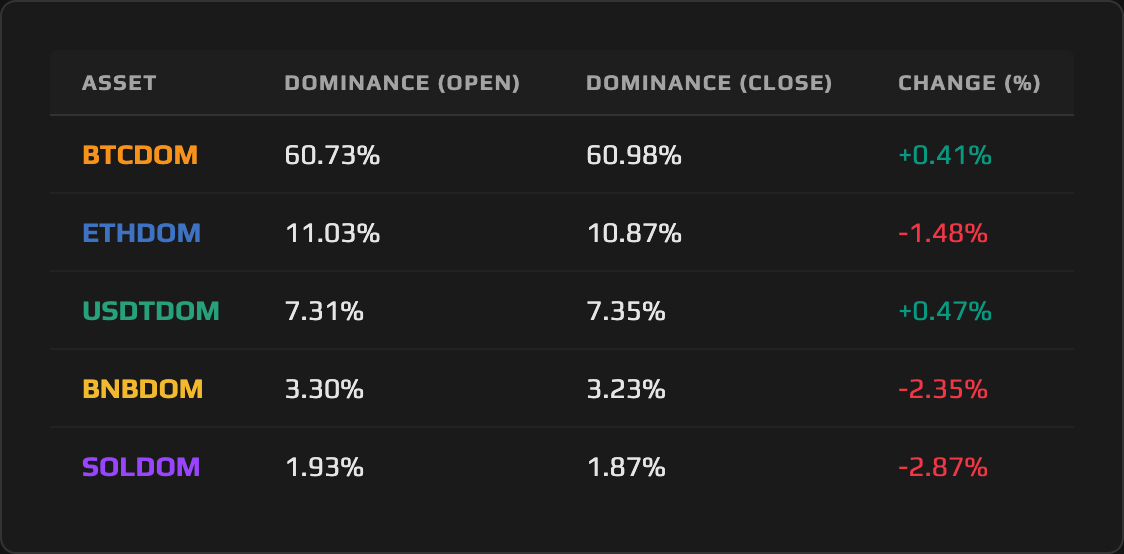
The prior week’s regime call has been confirmed in the sharpest possible way. USDTDOM tested 7.50% as resistance, not as a floor. The intraweek spike to 7.63% on FOMC day (Wednesday, April 29) was the defensive bid at full stretch, and it still could not close above the level that spent two months functioning as a support. By Sunday’s close, Tether Dominance sat at 7.35%, well below 7.50%. Meanwhile, BTCDOM at 60.98% is extending its hold above 60% into a second consecutive weekly close. Below the headline numbers, Solana Dominance led every covered pair in percentage terms at −2.87%, BNB Dominance declined 2.35%, and Ethereum Dominance shed 1.48%. The total crypto market cap contracted 0.55%, from approximately $2.571 trillion to $2.557 trillion. Losses in this environment were not the market falling; they were the complex redistributing, with BTC absorbing the relative bid and risk assets releasing it.
2. MACRO CONTEXT — THE BACKDROP
The total crypto market cap ended the week essentially flat, moving from approximately $2.571 trillion to $2.557 trillion, a decline of roughly $14 billion. That aggregate number conceals a week of violent intraweek dispersion. BTC’s price barely moved, closing at $78,542 against a Monday open of $78,645, a decline of 0.13%. Every other covered asset fell harder: ETH −2.01%, BNB −2.96%, SOL −3.53%. The Fear and Greed Index drifted from the greed zone into neutral across the week. The macro underpinning for that sentiment shift arrived Wednesday.
The April 29 FOMC meeting was the most contentious Fed decision in over three decades. The committee voted 8–4 to hold the funds rate at 3.50–3.75%, with four dissents, the most since October 1992. Stephen Miran voted for a quarter-point cut; Beth Hammack, Neel Kashkari, and Lorie Logan opposed any easing bias in the statement. Powell signaled the meeting may be his last as chair, though he will remain on the Board of Governors. The dissent structure mattered more than the hold: the implicit easing-bias support that had underpinned risk appetite into late April was stripped from the statement, and the market felt it immediately. USDTDOM’s mid-week spike to 7.63% was the dominance complex’s direct answer to that removal. The European Central Bank held at 2% the following day with eurozone CPI printing at 3% on energy, adding a second data point of stubborn inflation to the week’s macro texture.
Layered on top of central bank decisions was a deteriorating geopolitical picture. The US naval blockade of Iran, in effect since April 13, intensified through the week, with CENTCOM reporting 45 commercial vessels turned around or returned to port by May 1. Brent crude pushed above $110–$120, and risk-off pressure on global assets reflected the supply disruption. Against this backdrop, BTC spot ETFs recorded three consecutive outflow days from April 27 through April 29, totaling approximately $490 million ($263M, $89.7M, and $148.4M). For context, April overall was the strongest ETF month of 2026 at $2.44 billion in net inflows; the late-April reversal was a sharp inflection, not a trend shift. On the supply side, Tether minted $1 billion USDT on Tron on April 30. That mint was real supply expansion but did not prevent USDTDOM from receding by week’s end, a structurally informative signal in itself.
3. ASSET DEEP DIVE
Solana (SOL) Dominance
Open: 1.93% / Close: 1.87% / WoW Change: −2.87%
 The Structure
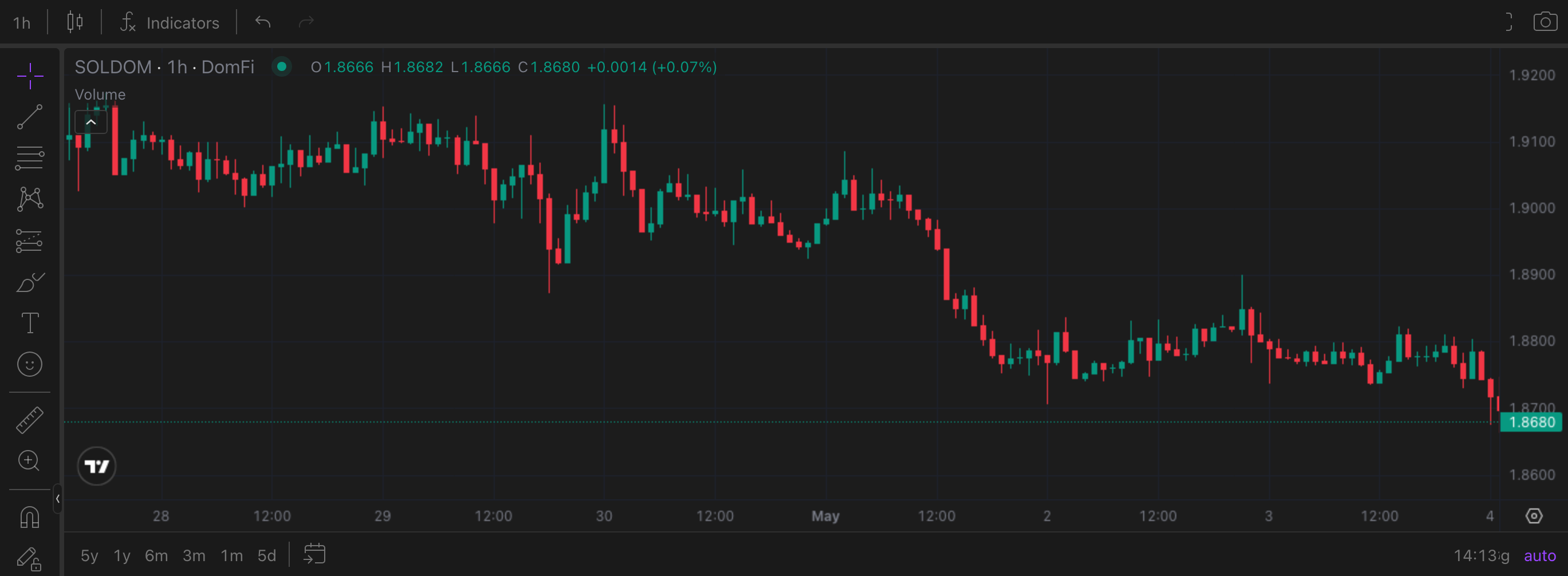
Solana Dominance opened at its weekly high of 1.94% and moved in one direction from there. The weekly candle is a clean bearish structure: the high set at Monday’s open, the low at 1.87% reached Saturday, and no meaningful intraweek recovery to suggest buyers stepping in. The 3.78% intraweek swing between 1.94% and 1.87% reflects genuine directional conviction rather than a chop range that happened to close lower. SOLDOM is printing lower-highs on the weekly chart. The 1.90%–1.94% band now functions as overhead resistance. The next test sits at 1.85%–1.90%; a clean close below would extend the contraction and remove the secondary floor.
This Week’s Price Action
SOL’s price declined 3.53% from $86.96 to $83.89, the sharpest drop among the covered assets. SOLDOM’s −2.87% weekly decline combines that price underperformance with BTC’s relative outperformance. Both forces worked simultaneously: SOL’s market cap shrank in dollar terms, BTC’s held steady, and the total market cap declined only slightly. SOLDOM was squeezed from both sides. The intraweek candle shows no recovery attempt of consequence. SOLDOM reached its Sunday low at 1.87%, and the late-week Visa and Circle announcements on May 3 did not generate any visible bid in time to alter the weekly print. SOL briefly touched above $84 on the Iran diplomatic proposal headline Sunday evening before reversing when Trump expressed skepticism, and that reversal sealed the close.
The Daily View
The daily picture is a steady erosion with no meaningful counter-trend sessions. SOLDOM held near the 1.93%–1.94% range through the first two days of the week before the FOMC shock on Wednesday pushed it through 1.90% alongside the broader risk-asset selloff. There was no recovery to prior levels after that break. Thursday through Saturday continued the grind lower, with SOLDOM tracking BNB Dominance almost in lockstep on the daily chart, both pairs bottoming Saturday at their respective weekly lows as BTCDOM reached its weekly peak at 61.05%. That timing tells the story: as BTC concentrated the late-week bid, Solana and BNB took the inverse. Momentum is pointed lower, and the daily chart shows no accumulation signal at current levels.
The Why
The SOLDOM decline this week has both a macro layer and a structural layer, and conflating them would miss the more important of the two.
The macro layer is shared with all risk assets: FOMC dissent removed the easing-bias tailwind, ETF outflows from BTC (a contagion signal for broader risk appetite), and Iran-driven oil pressure all pushed capital toward BTC and away from the altcoin complex. SOL was not singled out by macro; it experienced the same input as ETH and BNB. But it absorbed more of it. That differential is the asset-specific layer.
Spot SOL ETF cumulative inflows in April totaled $39.93 million. That marks the sixth consecutive monthly decline and a 92% drop from the $419 million captured in November 2025. The AUM of combined SOL ETFs crossed $1 billion during the week, and Goldman Sachs disclosed a $108 million position across those vehicles. Those are positive headline numbers, but they reflect stock, not flow. The institutional interest exists; the institutional demand is not growing at a rate sufficient to sustain SOLDOM expansion when macro turns risk-off. The AUM milestone matters less than the monthly inflow trajectory, which is pointing down for half a year.
The ecosystem dynamics add a second pressure. BNB Chain’s Four.Meme platform has been capturing memecoin volume that previously concentrated on Solana through the 2025 cycle. Solana’s memecoin ecosystem, which drove a meaningful portion of network activity and narrative momentum in prior quarters, has stagnated while BNB’s grew from near-zero to hundreds of millions in market cap. When the narrative edge erodes and the ETF flow momentum reverses simultaneously, SOLDOM loses two of its primary expansion drivers at once.
The late-week Visa stablecoin settlement announcement on Solana (May 3) and Circle’s $750 million USDC mint on Solana the same day are genuine catalysts, but they arrived too late in the week to alter the dominance print and, more importantly, represent adoption announcements rather than confirmed flow events. Whether Visa’s settlement expansion and Circle’s mint translate into sustained SOLDOM demand is the forward question, not the backward description.
The Outlook
Three scenarios from the 1.87% close. In the base case, macro stabilizes around a neutral FOMC posture, oil pressures moderate, and the Visa/Circle Solana announcements generate genuine settlement volume over the coming weeks. SOLDOM consolidates in the 1.85%–1.92% band as the pressures from declining ETF inflows and ecosystem competition are partially offset by adoption catalysts. The 1.85%–1.90% level holds as a floor.
In the bull case, NFP on Friday May 8 prints soft enough to revive easing expectations, which broadly benefits altcoins; SOLDOM recovers toward 1.92%–1.96% as the Visa/Circle announcements translate into visible settlement flow data. The narrative flips from “ecosystem stagnation” to “institutional adoption pipeline,” and the dominance picture follows.
In the risk-off scenario, NFP prints hot (eliminating any near-term cut probability), combined with Iran escalation sustaining oil pressure and the $753 million unlock week of May 4–10 generating supply pressure. SOLDOM breaks below 1.85%, extending the contraction into territory the pair has not held in months. That scenario also depends on whether Visa and Circle’s Solana commitments provide any floor bid; if adoption flow proves durable, the downside may be cushioned even in a macro-driven risk-off event.
4. THE DOMINANCE MATRIX
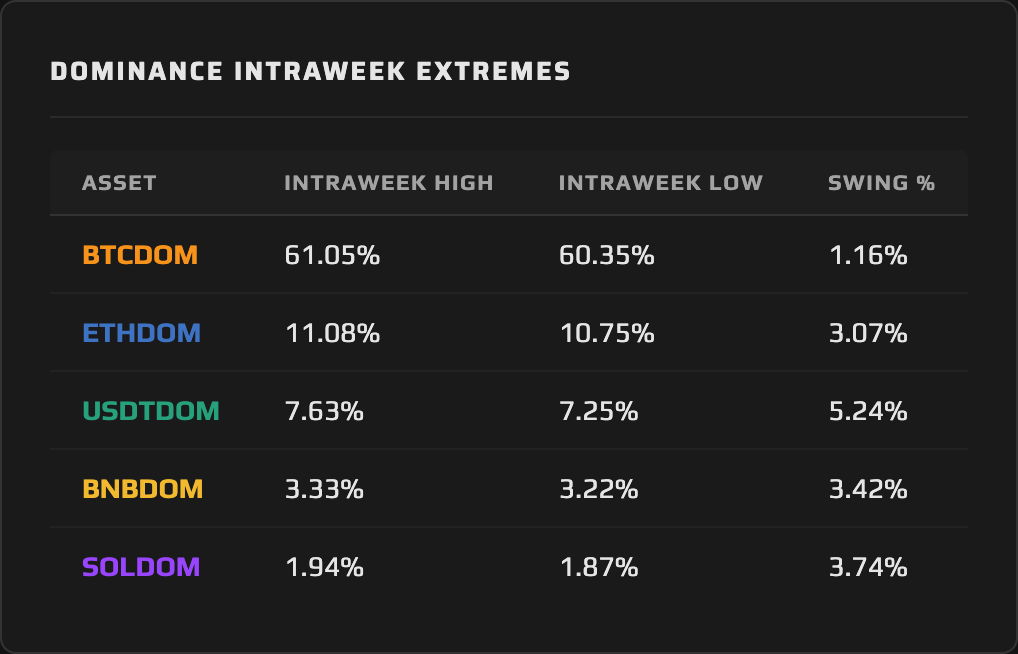
BTCDOM, ETHDOM, USDTDOM, and BNBDOM collectively describe a single week’s tension: a mid-week macro shock that briefly activated the full risk-off apparatus, followed by a partial reversal that left the line intact but tested at its edges.
Rank the week’s moves by magnitude and a pattern emerges immediately. BNBDOM (−2.35%) sits closest to SOLDOM in the loss table. USDTDOM (+0.47%) and BTCDOM (+0.41%) are the two gainers, separated by 0.06% in their weekly change. Ethereum Dominance at −1.48% occupies the middle. That clustering is not coincidence; it reflects a week where risk assets fell and stablecoin pairs gained, but the conviction of the flight was interrupted mid-week and partially reversed by Friday’s close.
BTCDOM advanced from 60.73% to 60.98%, its second consecutive close above the 60% level. The mechanism is the one the prior week’s analysis named: BTC barely moved in price (−0.13%) while every other covered asset fell harder, and the total market cap contracted only slightly. BTC’s market cap held steady while the rest of the complex shrank, lifting BTCDOM by what is best described as relative absorption. The late-week timing reinforces this: BTCDOM reached its weekly peak at 61.05% on Saturday, precisely when BNBDOM and SOLDOM were both bottoming. Three consecutive ETF outflow days from April 27–29 totaling approximately $490 million did not reverse the dominance gain, a signal that the underlying BTC bid runs deeper than one week’s ETF flow data can capture.
USDTDOM’s headline number is +0.47%, but that close-to-close figure compresses the real story into a single misleading number. The 5.17% intraweek swing (from a low of 7.25% Monday open to a high of 7.63% on Wednesday FOMC day) is the largest of any covered pair this week, and it captures a week the close-to-close number obscures entirely. The mid-week spike to 7.63% briefly pierced back through the 7.50% line that last week’s close confirmed as the new resistance. That pierce was not a reclaim. USDTDOM could not sustain a close above 7.50% on any daily bar after Wednesday’s spike, and by Sunday the level sat at 7.35%, well below 7.50%. The contrast between the headline +0.47% and the genuine mid-week defensive intensity that the 5.17% swing represents is the week’s sharpest analytical signal: the defensive bid is alive, but it is not strong enough to break the regime. Tether’s $1 billion USDT mint on Tron Thursday is worth reading alongside that dynamic. The supply expansion was real, but it did not push USDTDOM higher; instead, the mint was offset as existing demand receded from the FOMC peak. The intra-stablecoin picture extends further: the $688 million aggregate stablecoin supply expansion across the week, with the Sunday spike to $320.34 billion driven in significant part by Circle’s $750 million USDC mint on Solana, reveals a stablecoin complex that is growing in aggregate even as Tether’s share within that complex remains the more important question. That intra-stablecoin rotation, USDT expanding supply while USDC captures adoption-driven minting, is a dominance story within the dominance story.
ETHDOM declined 1.48%, from 11.03% to 10.87%. The week’s high was 11.08% at the Monday open; the week’s low was 10.75% on Wednesday, the same mid-week FOMC shock that spiked USDTDOM and bottomed every risk asset. ETHDOM recovered from 10.75% to 10.87% by the close, a partial but incomplete rebound. The setup is a tension between genuine institutional interest that has not yet converted into dominance gains and near-term macro headwinds that keep the pair under pressure. ETH ETFs posted their first monthly net inflow since October 2025 in April at $356 million, a reversal of a meaningful trend. The Glamsterdam upgrade in June and the staking ETF pipeline remain forward catalysts. But ETHDOM’s weekly candle this week (high on open, low at FOMC, partial recovery) is the dominance charts’ way of saying that the institutional narrative is providing support at the lows, not a bid for expansion. The 10.75%–10.87% range is the band to watch: a break below 10.75% would challenge the cycle’s support and force a reassessment of whether the April ETF inflow reversal was durable.
BNBDOM declined 2.35%, from 3.30% to 3.23%, with BNB’s price falling 2.96% across the week. BNB’s 35th quarterly burn, which destroyed approximately $1.02 billion worth of tokens (1.57 million BNB) in mid-April, provided no dominance defense in the week that followed. BNBDOM bottomed on Saturday at 3.22%, the same session where SOLDOM bottomed. Both pairs shed ground as BTCDOM reached its weekly peak and the late-week BTC concentration captured what remained of the risk-asset bid. BNB’s memecoin ecosystem development, which has been pulling volume from Solana through the Four.Meme platform, is a genuine fundamental narrative, but the dominance data reflects that gaining ecosystem share within an altcoin category does not insulate a pair from macro-driven dominance compression when BTC is the beneficiary of the flight.
Synthesis: This week’s full dominance picture describes a market that experienced a genuine risk-off shock mid-week and reflected it back without breaking the ceiling. BTCDOM defended above 60%; USDTDOM tested the 7.50% line as resistance and closed well below it; ETHDOM, BNBDOM, and Solana Dominance all shed ground as risk assets broadly underperformed BTC. The setup is not in transition; the FOMC shock was a test, and the line held. BTC concentration continues, stablecoin bids remain available but disciplined, and the altcoin pairs are operating in an environment where macro headwinds and weakening flow data are compounding. The week’s loudest signal is the 5.17% USDTDOM swing that left no lasting mark on the close: the reflex fires, it tests its own ceiling, and then it recedes. Until that pattern breaks, the dominance charts are reading the same setup they confirmed last week.
5. THE WEEK AHEAD — EVENTS CALENDAR
Monday, May 4 — Visa stablecoin settlement on Solana goes live. WLFI governance vote on 62B token unlock proposal expected to finalize (99.5% support at last count, two-year cliff, 40.7B tokens unlocking; insider burn of 10% included).
Thursday, May 7 — Initial Jobless Claims (Prior: ~214K).
Friday, May 8 — April Employment Situation (NFP) at 8:30 ET (Prior: 178K). This is the first major macro print following the contentious 8–4 FOMC hold and the removal of the easing-bias statement.
Unlock calendar (week of May 4–10): $753 million in total cliff unlocks across the crypto complex. That makes it the single heaviest week in the May–June window.
What to Watch for Dominance: NFP Friday is the week’s defining binary for the dominance complex. A soft print (payrolls below 150K or a rising unemployment rate) revives near-term cut expectations, benefits risk assets broadly, and would likely see USDTDOM press back toward 7.20%–7.25% while BTCDOM holds above 60%. A hot print (200K+ or persistent wage growth) eliminates any remaining near-term easing probability, extends the higher-for-longer repricing the FOMC statement already began, and could push USDTDOM to test 7.50% as resistance in a second successive week. For Solana Dominance specifically, the Visa settlement launch and the Circle USDC mint on May 3 are the catalysts to track against the $753 million unlock pressure: if adoption flow proves visible and durable while the unlock week doesn’t generate sustained selling, SOLDOM may stabilize in the 1.85%–1.90% band; if the unlocks dominate and macro stays risk-off, the next structural support level comes into view. The WLFI vote finalization, though generating headline attention, is unlikely to produce direct dominance movement; governance votes of that structure tend to be priced in well before execution.
6. CLOSING REMARK
The regime that the past two weeks established is holding under pressure. USDTDOM’s 7.63% intraweek peak was the most serious test of the 7.50% resistance line the current cycle has produced, arriving on the back of the most hawkish Fed vote split in more than three decades, three consecutive ETF outflow days, and an escalating naval blockade. The level held as resistance on a closing basis. BTCDOM extended its hold above 60% into a second consecutive week. The pattern the prior weeks predicted is playing out with notable precision: the defensive bid exists, it fires on macro shock, and it recedes without breaking the line.
What this confirmation does not address is the underlying fracture in the altcoin pairs. SOLDOM’s −2.87% weekly decline is not solely a macro story. Six consecutive months of declining SOL ETF inflows, ecosystem competition from BNB Chain’s memecoin infrastructure, and price underperformance against an already-weak market combine into a sustained pressure that persists regardless of what NFP prints Friday. The late-week Visa and Circle catalysts are genuine, but they are adoption signals, not flow signals yet. The dominance charts will tell that story in the weeks ahead. Until SOLDOM can sustain a weekly close above 1.92%, the contraction is intact, and the altcoin rotation that last week’s analysis flagged as the open question remains open.
This content is produced by domination.finance for informational and educational purposes only. Nothing contained herein constitutes financial or investment advice. Always conduct your own research.